Showing posts with label sculpture. Show all posts
Showing posts with label sculpture. Show all posts
Thursday, March 4, 2010
The Way Things Go and Pass
Fischli and Weiss, Der Lauf Der Dinge (The Way Things Go), video, 30', 1987
Honda Ad, 2003
OK Go - This Too Shall Pass, 2009
I remember the choreographer João Fiadeiro once showing Fischli & Weiss's work during some seminar or workshop and talking about what in his mind made it so impressive: necessity. Although it might seem like anything can happen, what happens is exactly what needs to happen. A tautology that evolves in time? But isn't any proof precisely that - a dynamic tautology?
So is it because it's a proof that it's so appealing?
A proof of what?
Of how things go, we are tempted to say.
Which, of course, is just silly talk. It's precisely because things don't go this way that we enjoy it so much. It's because the unexpected becomes necessary.
What about this "evolution"? The work of art turned into a commercial turned into a music video. Don't expect any moral judgement on that. Actually, I enjoyed all three videos.
We could discuss the question of authorship. But we won't. (Fischli & Weiss threatened to sue Honda).
Here's what I've been pondering on: what exactly are the differences?
Because, once you've accepted that they're all in the same category (actually, this type of inventions is called either Heath Robinson contraptions (UK), or (more commonly) Rube Goldberg Machines (US) and have been in popular culture at least since the beginning of the 20th century), you can see into how very different they are.
So what makes it an art project, a commercial, a music video?
If we turn the volume off, what changes?
If we put music, or switch it from one video to another?
The timing, the materials, the way things go and pass.
What sort of universe appears in each of them?
Yes, that's precious: they each have their own universe. They are entities. You can easily find yourself around them, with their texture, their dynamics, their smell...
One more thing: aren't they each hiding in their specific ways this very basic urge for things to make sense?
If that is so, it's beyond necessity or discovery. It's the comfort of order. The sense that somewhere beyond the frame, things are just waiting to come into action, to move into view. And their potential is already in perfect harmony with the moment when they will become what they are meant to be. The best of possible worlds.
It shouldn't come as a surprize that these delicately balancing certainties remind us of childhood. Read more "The Way Things Go and Pass..."

Tuesday, December 29, 2009
The Splendorous Form of Noise
To see the following video you should enlarge it (double-click once playing).
The above is a compilation of works by the Swiss artist Zimoun.
1. Funny, one keeps telling oneself, enough of the minimal already, somehow feeling that less is a bore should be embraced, and the outrageously overflowing art of the recent years - appreciated and encouraged. And then, something like this appears, and it's irresistible. We've seen things from this universe before, also on this blog, and yet, the simplicity, yes, the damn purity takes over again.
2. I had a chance, recently, to visit several large factories. There were wonders there that could probably match most of the things on this video. Yet there was one thing they couldn't do: be useless. It's the sheer uselessness of it that gives it the power. We are not attached to anything but the thing. Art as the thing-that-cannot-be-used? Not necessarily, not in some purist sense. Great industrial design is to be cherished. And yet, there is a level of insanity here, of out-of-this-world-ness, that takes us to an exotic land, allowing for the silliest and most delicious connections to be made.
3. Luxury requires waste. A truly luxurious lifestyle is one where perfectly good things get wasted, as if to outplay their natural use and dying away. The true master of luxury seems to be saying her opulence is so great, the very perseverence of things is no match - they lose their original function and only exist to the extent they are participating in this out-of-this-world-ness of luxury.
You know what I'm aiming at? Here's the hypothesis:
4. This, this minimalist joyful pleasure-making, is the true luxury. Not the apparent richness of the new complexities. In the world of useless purity, everything only serves the joy of simple aesthetic pleasure. More complex works are not quite like that - they have an inner game to play. The elements enter a dialogue, start relations and societies, with their conflicts and functions and disruptions. Here, there is only the ping of a shot of pleasure. This engine moves nothing. It is here to make me smile (or bring inspiration, or scare) - and I turn it off as soon as I have. And don't be mistaken - if I had one of those and got bored with and could afford it, it would go to waste.
4a. Ah, you might say, but the truly great art is one we don't get bored with. Possibly. Yet how often do we actually go back to contemplate (not just think about or admire or analyze) a work of contemporary "minimalist" art? Does it mean it's because it's not that great? What if it's about something else? What if it is an element of luxury, a game we play with ourselves, to feel the exquisite taste of the sophisticated dish, and then to ditch it as soon as we're fed up? It wouldn't be a question of bluff, of fakeness, of shallowness. It would be a question of use. Of why we crave it, this new. Of how we make it useful after all.
 David Foldvari, Wrestler
(via)
Monday, December 21, 2009
Earn your money


 The Minimum Wage Machine (work in progress), by Blake Fall-Conroy
The minimum wage machine allows anybody to work for minimum wage. Turning the crank will yield one penny every 5.04 seconds, for $7.15 an hour (NY state minimum wage). If the participant stops turning the crank, they stop receiving money. The machine's mechanism and electronics are powered by the hand crank, and pennies are stored in a plexiglas box.
Contrary to some other art experiments on work (I'm thinking of some of Santiago Sierra's early projects, but had I any memory, I'm sure a dozen other works would come to my mind), this, here, is not about objectifying labor. It takes the paradox of work-as-product in a somewhat different direction. If there is a minimum wage, any job should be paid the minimum wage. So turning the handle should actually always give you this result.
You can read a technical description of how it was constructed (didn't understand half of it) here.
Read more "Earn your money..."
Tuesday, October 27, 2009
In A Sentimental Mood

Sonnet 44
If the dull substance of my flesh were thought,
Injurious distance should not stop my way;
For then despite of space I would be brought,
From limits far remote, where thou dost stay.
No matter then although my foot did stand
Upon the farthest earth removed from thee;
For nimble thought can jump both sea and land
As soon as think the place where he would be.
But, ah, thought kills me that I am not thought,
To leap large lengths of miles when thou art gone,
But that, so much of earth and water wrought,
I must attend time's leisure with my moan,
Receiving nought by elements so slow,
But heavy tears, badges of either's woe.
(Shakespeare)
One more thing: The bone in the film is a wishbone:
The wishbone, known in anatomy as the furcula, is a sternum bone found in birds which is shaped like the letter Y. It is used as an attachment point for the wing muscles. It is so named because of a tradition: Two people pull on each side of such a bone, and when it breaks, the one who gets the larger part is said to have a wish granted.
The mechanical sculpture in the film is by Arthur Ganson. Some of his stuff is really awe-inspiring. Check this Machine with Artichoke Petal #2
Of course, it may bring to mind other art machines (Rebecca Horn, but also manyothers), but what I really appreciate here is the simplicity. Modest art is something to be cherished. It also reminds me of some of the musical experiences by the Portuguese musician Nuno Rebelo:
Even the really simple ones are really something: Machine with Chinese Fan
Is it kitsch? I don't care.
(via) Read more "In A Sentimental Mood..."
Saturday, October 24, 2009
The right and the rights
 So how was it for YOU?
Not all of Robert Grigolov's work convinces me. Some of it seems like simple tricks pour épater les bourgeois. But isn't part of the fun about discovering the value something has for you when taking out of a context which isn't necessarily one you appreciate?
 Why does the above installation have the title Dollar Bill? I don't know. I have some ideas, but I don't think I want to follow them. And, just as Daniel Pennac's 10 Inalienable Rights of the Reader, so any spectator has similar rights, among them, to decide arbitrarily where the work begins and ends for her.
 This doesn't need to mean any sort of glorification of ignorance. However, it does accept it as part of the deal. After all, the spectator is no less free than the artist, is he?
 This should be a very obvious question. Aesthetic relativism is something seemingly accepted. Yet the contemporary art world seems to specialize in "right" ways of looking at its creations.
 Anything goes - yet there is still plenty of exciting space for dialogue. Tastes are indeed something we discuss and shape, aesthetic experience is a beautifuly shapeable thing. And yet one of the most difficult things is to stay within the play of common value-seeking and exploration of personal experience, and not move into the discourse of competence, the universe of authority, which might sustain a big chunk of what the contemporary art world is about, but is hardly enjoyable for those of us who like their artflesh stupendously raw and intimate.
(via) Read more "The right and the rights..."
Tuesday, October 13, 2009
Art after commerce
Here's a recent work made by Julius Popp, a German artist:
And here's a commercial product present since 1989:
Classic questions:
How much of the value is the originality of the project?
How much is there left for the concept? The execution? The richness of the universe that is being created? The "art codes"?
The bluff?
Should one stop/diverge a project upon realizing one is following another's path too closely?
This latter question is quite recurrent among many of the artists I know. Some opt for stopping, while others simply don't let go of their toy. After all, they say, isn't it always mine in the first place? Unintentional plagiarism? So what? If you focus on what you are, on your own path, shouldn't it always lead to an original work? In the best of possible worlds? Read more "Art after commerce..."
And here's a commercial product present since 1989:
Classic questions:
How much of the value is the originality of the project?
How much is there left for the concept? The execution? The richness of the universe that is being created? The "art codes"?
The bluff?
Should one stop/diverge a project upon realizing one is following another's path too closely?
This latter question is quite recurrent among many of the artists I know. Some opt for stopping, while others simply don't let go of their toy. After all, they say, isn't it always mine in the first place? Unintentional plagiarism? So what? If you focus on what you are, on your own path, shouldn't it always lead to an original work? In the best of possible worlds? Read more "Art after commerce..."
Wednesday, October 7, 2009
It's All About You


Audience by Chris O'Shea. A very interesting technical description can be found here. Read more "It's All About You..."
Saturday, October 3, 2009
The Expecting Creator Of Matter
 Watch the edges; yet another birth, another coming-to, another attempt at elucidation, lucid, try lucidity, for a change, just watch the edges, and also, try to aim at the opaque, but where's the opaque in the translucid, and how, how does it
 Elucidation: an act of explaining that serves to clear up and cast light on. The splendid, harsh ambiguity of words, the clustering of them, the annoying coming-to, they do not leave us they do not, they do not leave us, an act of explaining, take that, an act, ex-plain, serves, clear, clear up, cast, cast, cast, light. On.
And as it is happening, you watch it take shape, this thing, this event, this work, this thing-in-work-in-process, which is you in the stupidest of senses, you have been feeding it and yes, you were the, the ur-text, but what with it, the bone, the rib, the biblical Eve, so clearly not you, going elsewhere, as you watch

All works by Loris Cecchini. Read more "The Expecting Creator Of Matter..."
Friday, October 2, 2009
After a conversation with AB
 Apparently, the National Railway Workers installed a handrail on Richard Serra’s sculpture in Duedingen, Switzerland. Why would anyone want the autonomy of the artist?
(via) Read more "After a conversation with AB..."
Wednesday, September 30, 2009
Polly Morgan's choir

What is this choir of possibilities you offer me? Where can it take us? What tragic song may be ours, what sort of future may a non-future contain? Then again, isn't it just a question of measure? Stop here. Stop here. The still. The gesture, frozen, with the impossible life no less possible than any other still. Still. Hold it more gently. Don't make your hand into a fist. Let them be flowers, let them be flowers, singing flowers, watching singing flowers, for just another, for just another still.
You can purchase this exclusive Polly Morgan print at murmurart. If you dare hang this on a wall. Read more "Polly Morgan's choir..."
Monday, September 28, 2009
In Hiding


Works by Janine Antoni (the first one is a sculpture - a cast of the artist - and not a photo of a performed action, as is the case with the second one).
And as a bonus, a work by her called Umbillical (2000), made of a "sterling silver cast of family silverware and negative impression of artist's mouth and mother's hand".
 Read more "In Hiding..."
Wednesday, September 23, 2009
Cattelan vs. Woodman
 Looking for the above gorgeous image by Francesca Woodman, I came across Lucilees post where she asks the ever-recurring question about appropriation vs. plagiarism, in the context of the two works below:
 Cattelan's installation, untitled, from 2007.
 Woodman's photo, untitled, 1977.
The work seemed like a clear quote to me, but I searched a bit more.
Cattelan presented the installation in 2008 at his Bregenz Kunsthalle (the site seems to have almost no working pages) exhibition. It was on the highest floor of the building, and it looked like this:

Impressive. It's quite interesting, though, to see to what extent the presentation of a work can obscure/transform its dynamics. The first picture of Cattelan's piece without this second one creates a significantly different framework. (According to one commentator, this was the first time Cattelan used someone else's architecture to stage his piece.)
My Polish coleagues have linked Cattelan's work to feminism and eschatology. Crucifiction, yes, but what is beyond? Also, the white nightgown suggests a patient, eternal patient, hysteric person...
Although Iza Kowalczyk is right to point out that this work stresses the crucifiction more than the hanging in Woodman's version (where the chair in the front created a classic reference to this way of committing suicide), there is something in both these installations that I found crucial, and missing in the comments: the portrayed woman is not crucified. She is suspended by her own arms. It is a very uncomfortable position and requires significant effort.
 There is a play going on here between victimization, self-victimization and empowerment. The subject self-objectifies thus getting higher.
One other thing, concerning a discussion on one of the sites, about eroticism. Is this too pure to be erotic? To me it seems to bring about the right amount of frustration by being so unbearably decent, and yet stretched to the limits . This is much more explicit in Cattelan's work - an installation, bringing about a specific, ambiguous visual perspective. This frustration of power, which plays namely on the the relation between the viewer and his subject, is a trademark of many of Cattelan's works. It's what often irritates me. And what makes me come back. Read more "Cattelan vs. Woodman..."
Sunday, September 20, 2009
Higher


Beautiful Steps #2, by Lang/Baumann at the Utopics exhibition in the Swiss city of Biel. Read more "Higher..."
Sunday, September 6, 2009
Far Away So Close
The San Francisco LAB just closed their 25th-year-anniversary exhibition called PastForward, where they made an open call to young artists to respond to works of the established ones who came out of The LAB. The result seems to have been quite exciting - you can take a look at some pictures at this site (with some great jazz playing on the site - which unfortunately can't be turned off...).
My favorite work, especially given the distant perspective (I'm in Warsaw now) is the Viewing Platform by Ellen Babcock:

Perfect for any vernissage! (And after all, what would contemporary art be without the vernissages!) It plays with an essential trait of contemporary art: centrality. You are taller, you see further, and as if by chance you are hence appreciated. You become the spectacle. Very tiring indeed. And fun, if you forget the impossibility of an intimate contact with the remaining works. I know, the people become the work, and still...
I would love to create a portable version of this. Like a small podium with railings that you could carry around the opening (wheels?), or rent, or receive if you are a VIP guest. Or just have one of my own, though the most enjoyable part might be having several people on this higher level, among the crowds. And believe you me, at the exhibition openings of the main Warsaw art centers, it would come in handy.
--
Here is what the curatorial note says:
My favorite work, especially given the distant perspective (I'm in Warsaw now) is the Viewing Platform by Ellen Babcock:

Perfect for any vernissage! (And after all, what would contemporary art be without the vernissages!) It plays with an essential trait of contemporary art: centrality. You are taller, you see further, and as if by chance you are hence appreciated. You become the spectacle. Very tiring indeed. And fun, if you forget the impossibility of an intimate contact with the remaining works. I know, the people become the work, and still...
I would love to create a portable version of this. Like a small podium with railings that you could carry around the opening (wheels?), or rent, or receive if you are a VIP guest. Or just have one of my own, though the most enjoyable part might be having several people on this higher level, among the crowds. And believe you me, at the exhibition openings of the main Warsaw art centers, it would come in handy.
--
Here is what the curatorial note says:
Ellen Babcock responds to Lauren Davies with a sculptural installationRead more "Far Away So Close..."
that addresses Davies’ engagement with representations of the natural world. Based upon Babcock’s visit to a tiny museum in Twillingate, Newfoundland – a visit Davies herself had made prior to Babcock – the sculpture teases out the differences between the two artists’ approaches to the tropes of natural history display. Encountering a stuffed polar bear in the museum, Davies responded with a gently mocking mixture of humor and pathos meant to remind us of the absurdity of the way taxonomies simplify and freeze the fluid mysteries of life. Babcock, on the other hand, found the quasi-encounter visceral and beautiful. While she sees Davies as opening up a space for the Real in an iconoclastic rejection of the traditions of natural display, Babcock looks for vestiges of the Real in the moment of encounter when disbelief is suspended.
Saturday, August 15, 2009
Public Art, just not for the public
From Chicago's pride, the Millenium Park, comes a cruel, yet fascinating, story of public art gone wrong.
BOTH of the public sculptures it opened recently, one by the Van Berkel atelier, and the other by Zaha Hadid, got damaged by the all-too-loving public.
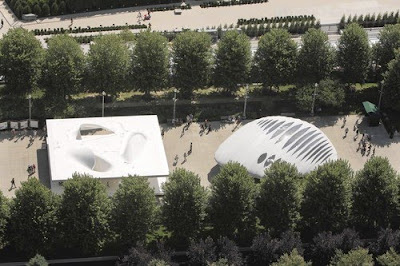 Looks quite nice from above, doesn't it? If you go to ground level, it's even more inspiring. Here's a look at Hadid's work:
 The entire structure, made of aluminum, is covered with cloth. Now let's take a look inside this spaceship.

Get the picture?
Not so difficult to imagine people stepping on the cloth.
One of the key statements of the manifesto of a group of artists presenting the exhibition Unusually Rare Events is that the artist does not need to think about the spectator when creating the work. Agreed. However, when creating a public work of art (mind you, to some extent any work of art is public), he might want to consider that his work will possibly not only be appreciated like this:
 but also like this:

 And those, of course, are the "nice" visitors.
The question arises: should we stay with "public-proof" solutions? Hire teams of guards to keep the aura going? Or maybe consider every mark and hole as part of the (pardon the pun) holistic concept of the work of art?
Now I wonder how these marvellously designed shoes by Zaha Hadid feel:


 Not to mention the London Aquatics Centre, to be one of the main venues of the 2012 Summer Olympics.
(via) Read more "Public Art, just not for the public..."
BOTH of the public sculptures it opened recently, one by the Van Berkel atelier, and the other by Zaha Hadid, got damaged by the all-too-loving public.
 Looks quite nice from above, doesn't it? If you go to ground level, it's even more inspiring. Here's a look at Hadid's work:
 The entire structure, made of aluminum, is covered with cloth. Now let's take a look inside this spaceship.
Get the picture?
Not so difficult to imagine people stepping on the cloth.
One of the key statements of the manifesto of a group of artists presenting the exhibition Unusually Rare Events is that the artist does not need to think about the spectator when creating the work. Agreed. However, when creating a public work of art (mind you, to some extent any work of art is public), he might want to consider that his work will possibly not only be appreciated like this:
 but also like this:
 And those, of course, are the "nice" visitors.
The question arises: should we stay with "public-proof" solutions? Hire teams of guards to keep the aura going? Or maybe consider every mark and hole as part of the (pardon the pun) holistic concept of the work of art?
Now I wonder how these marvellously designed shoes by Zaha Hadid feel:


 Not to mention the London Aquatics Centre, to be one of the main venues of the 2012 Summer Olympics.
(via) Read more "Public Art, just not for the public..."
Saturday, July 11, 2009
Anthill sculpture
It's my birthday, so today I'm leaving you with some new art that was not meant to be art, made by a scientist in collaboration with ants... (Don't mind the off-screen commentary and enjoy the visual ride).
(If you're interested in the ant-not-art part of it, you can see the 6-minute documentary episode here)
(Thanks Pusty!) Read more "Anthill sculpture..."
(If you're interested in the ant-not-art part of it, you can see the 6-minute documentary episode here)
(Thanks Pusty!) Read more "Anthill sculpture..."
Thursday, May 28, 2009
Looking up


Master, placid are
All the hours
We lose,
If, in losing them,
Like in a vase,
We put flowers.
(fragment of a poem by Ricardo Reis, aka Fernando Pessoa)
Tommi Toija, the author of the above sculptures, has an exhibition at the Institut Finlandais in Paris until the end of June. Read more "Looking up..."
Monday, April 6, 2009
Dress-up
Two ideas for an eye-opening surrounding:
Chris&Ruby's Footies, socks for your chairs

and TRASH:Any Color You Like, a rapidly growing project by Adrian Kondratowicz, based the simple idea that trash bags are also sculptoric forms.


(via) Read more "Dress-up..."
Chris&Ruby's Footies, socks for your chairs

and TRASH:Any Color You Like, a rapidly growing project by Adrian Kondratowicz, based the simple idea that trash bags are also sculptoric forms.


(via) Read more "Dress-up..."
Wednesday, March 25, 2009
Jenny Holzer - The Meaning of Everything

There once was a man who wanted to discover the meaning of everything.
He wandered across the world, searching for someone wise enough to explain to him what all this was about, what was the meaning of everything.
After many years, in a distant land, he was told there is one Sage who knows the secret, the meaning of everything.
So he traveled to the huge house where the old Sage lived. He knocked at the door, but there was no answer. He tried opening the large wooden door. It was not locked. The traveler entered the house, to find himself in an enormous hall with walls covered in shelves with books. He walked further in and entered a large room also filled with books. He moved to the adjacent room - and discovered that there, too, shelves were everywhere, and on them - only books. He approached one of the shelves and picked up a random volume. He opened it, and inside it, he saw the letter N, filling the pages. The pages of the book were all but rows of NNNNNN...
He picked up another book, opened it - the book was filled with TTTTTTT.... He tried another one, and another, and each of them was filled with but one letter.
Flabbergasted, the traveler wanted to sit down, when the Sage came in. He was an old, grey-bearded man, just as the fairy-tales have it.
"Sir, said the traveler, I don't understand, there is... I don't understand!"
The Sage smiled, and replied, "Now all you need to do is connect the letters."
Although text is at the heart of her work, Jenny Holzer is not really a writer. She is rather a reader. Her work is not so much about text, as it is about giving body to text. But, as the authorship becomes blundered (Holzer signs the work, but none of the texts that compose it), writing is always re-writing, and thus, it is fundamentally about the embodyment reading.
Somewhat following the path suggested by the likes of Barthes, Baudrillard or Foucault, Holzer is a semiotic DJ, reconfiguring and re-shaping the meaning that seems to have been there long ago. If her own words appear in the works, they seem to remain transparent, undistinguishable from external sources. (Remember the famous line, "Protect Me From What I Want"? Can you say if it was Holzer's own sentence, or an appropriation of someone else's?).
In one of her recent projects included in the Protect Protect exhibition (read an insightful review here), Holzer takes on Iraq and the question of torture. In a work showcased at the TimeOut NY site, she reproduces original, recently declassified documents of the US Army. What is the artist's role? How different is it from strictly political work?
Yes, this is Warholesque. And yes, it is somewhat controversial to have an artist of Holzer's renown decide that this was the right approach and means for this specific subject.
One excellent and cruel review puts it bluntly: if it is about raising our awareness, Warhol's works were good proof that in terms of political awareness this can hardly be a success.
But we can see it from another angle: contrary to Warhol, Holzer gained her reputation on working on questions of morality, and contrary to what she herself claims, values have always been a crucial issue in her work. Thus, as her work can already be seen from this engaged perspective, can't we interpret the careful selection of documents as a sort of curatorial answer precisely to warholian esthetic relativism?
Yet the question remains: do we really need this reader? Do we not see the same documents elsewhere? Our performativity-sensitive eyes are accustomed to seeing the terrific game of language that, say, the map of the Iraq invasion represents. What does purple paint and canvas change in this reading, for us, today?
(image on top from here) Read more "Jenny Holzer - The Meaning of Everything..."
Wednesday, February 25, 2009
Two works by Christiane Löhr


Oh were this the universe!
Were it but a combination of lines, a simple picture of perfection, were the universe a set of twigs and seeds with their mathematical omnipotence!
Oh were there nothing else, nothing but the point where everything meets, nothing but the shape it all embodies. And the shadow of the reflection of a shadow of the Work, just to outscore its very depth of space, just to give us the distance we need to be closer.
Oh were it all we need, the joyful meeting of vectors, the unswerving presence of fragility.
Oh were there no shadow in the top left corner, coming from elsewhere.
Both pictures are of sculptures by Christiane Löhr. Read more "Two works by Christiane Löhr..."
Subscribe to:
Posts (Atom)
