Saturday, September 16, 2006

Al Magnus: taking children seriously

For Al Magnus, it all started with having children.

How surprizing is that? Of course, these are images of fairly tales. Some actually ring a bell. Most are rather fairy tales in themselves. But to start off, remember they were not meant for us, but for the little ones. Hopefully, that can be a good enough excuse to enjoy, as we usually enjoy the things that weren't meant for us.

Then, of course, there is more. The above image, called Paisagiste II (Landscape Designer II) has two versions. The first one is in color. This one, however, is quite different. By taking away the color, the general atmosphere becomes heavier. But there is another change. The boy pulling on the rope all but disappears. (Yes, there is a boy pulling on the rope). Suddenly, we discover the designer is not quite the one we thought it were. Maybe, because in the tales we know, we can only think of one designer.
But isn't the designer someone with the power to reinvent? To construct, but also, to make a Very Silly Thing (La Grosse Betise)?
Maybe, the power of attraction of children's tales is not that they're far-fetched, incredible, fantastic, but that they design things in such a way that we feel this world-changing design on every step? This is a big difference, since we rarely associate children's stories with the creation of order. Come to think of it, it is an order that they have in common with some, maybe not all, art. And so, the trivial idea that artists are the adults that remained (or went back to being) children can be understood in a whole different way. Artists treat designing seriously.


Read more "Al Magnus: taking children seriously..."

ARTISTS IN LOVE, part five

The meanest illustrator who ever lived was surely James Montgomery Flagg, who was always quick with an unkind remark.

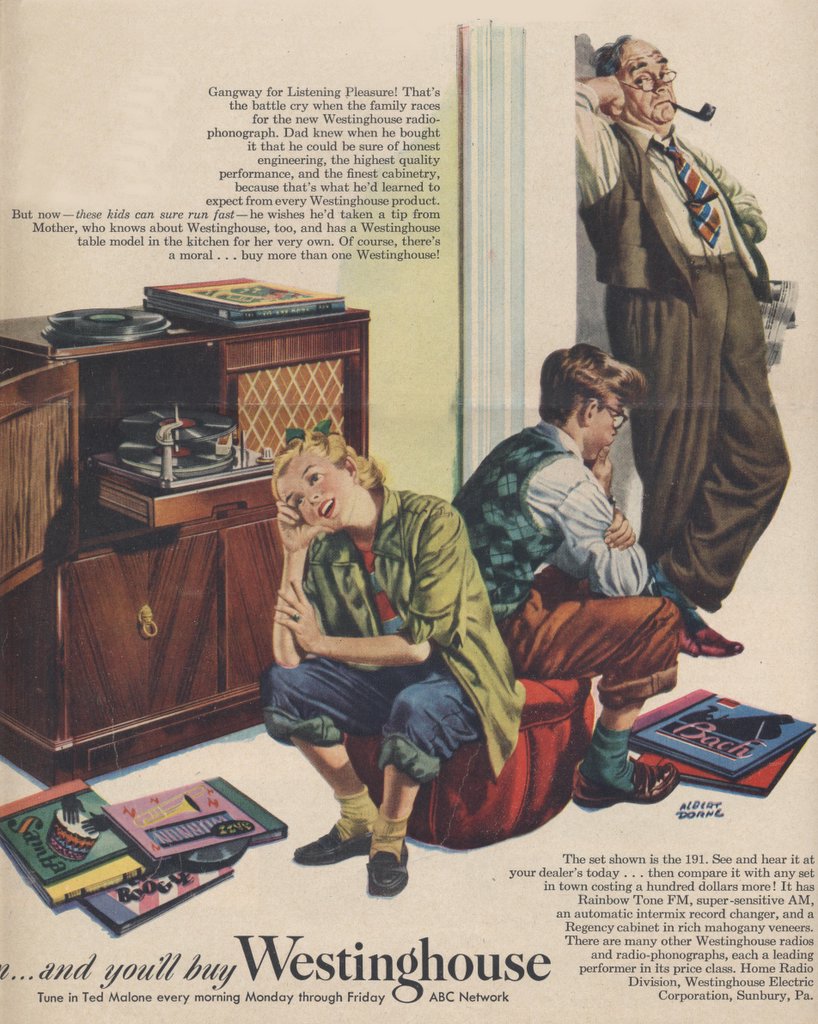
Flagg's autobiography makes fun of the contrast between illustrator Albert Dorne and Dorne's wife. According to Flagg, Dorne's wife was beautiful, petite and elegant while Dorne looked like a brute who might murder you in a dark alley.


It's true that Dorne carried the psychic scars from his childhood in the slums. He had to scratch and claw his way out of Hell's Kitchen not only for himself but for his mother, his two sisters and his younger brother. He worked as a boxer and dealt with terrible situations that, in his own words, left him "hard boiled." Not surprisingly, he became a heavy drinker with a difficult personality. He rapidly went through three marriages.

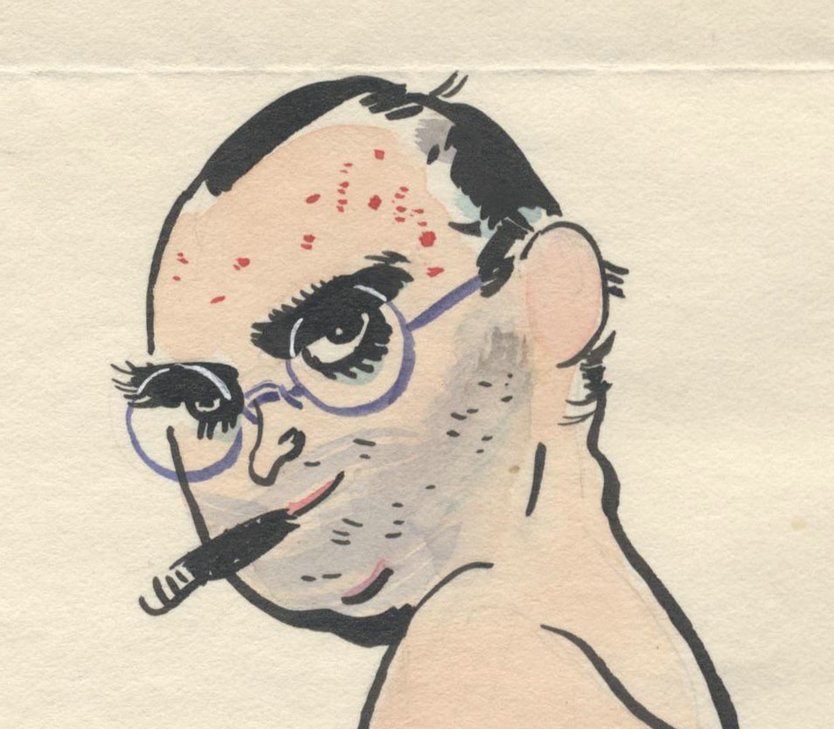
But somewhere along the way, Dorne began to outrun his demons. He seemed startled to find himself capable of a permanent relationship with his fourth wife. After fifteen years of marriage, he said "I am slowly and definitely being convinced that this is it." This self-portrait from Dorne was found among his wife's personal effects after she died:


In the safety of his marriage, even the "hard boiled" Dorne could be reborn as the nubile nymphette from September morn.

Biologists used to wonder why nature invented such a complicated, impractical process as sex, which requires two parties coming together to perpetuate the species. Compared to the asexual reproduction that worked so well for our single-celled ancestors, sex seems highly inefficient. Two separate organisms must overcome many obstacles to find each other and mate. And that's even before you take into consideration the problems caused by that time you showed up late for dinner.


The answer, biologists tell us, is that the parasites and bacteria all around us evolve more rapidly than we do and would soon learn to evade their hosts' immune systems if we did not rearrange our genes with each new generation. By blending ourselves with another person, we force our natural enemies to begin all over again.


The same observation might be made about relationships in general.

When two individuals combine, they have a chance to fill in blind spots and compensate for weaknesses that might otherwise harden during a solitary existence. It is not easy to "rearrange your genes" with another person (as Dorne's first three marriages demonstrate). However, the process can sometimes normalize thoughts and behavior which, if left to grow in isolation, might overtake us like the parasites and bacteria. As Bernard Malamud wrote, "if a man is not careful his own thoughts can poison him."

In the 33 years of his last marriage, Dorne overcame his childhood traumas. He ended up a nationally prominent illustrator, president of the Society of Illustrators and wealthy beyond his wildest dreams. He was an art collector and philanthropist, founder of the Famous Artists School (and then the Famous Writers and Photographers schools, with more than 50,000 students in 55 countries). He was appointed to the President's Committee for the Employment of the Handicapped and devoted substantial time to nurturing young talent. A well deserved happy ending for a very special and powerful man.

Read more "ARTISTS IN LOVE, part five..."

Wednesday, September 13, 2006

For V.

The work, by Maarten Vanden Eynde, is called Rave Nature, but here is something interesting: the photo's file on the artist's server is named podium. I much prefer this second name. Also, as we can read here, contrary to many other works of land art, the work as such was not the picture, but the thing itself. It was part of a festival, and was actually an installation that at night would be lit with disco lights and a stroboscope, and smoke would come out while a song would play... I'm not really sure if I still enjoy it as much. One thing is for sure: this picture certainly doesn't convey the idea of rave. Which might be part of the trick, come to think of it. As if the stage was set, but impossible to comprehend during daylight? On a more general level, it's fascinating how the opening of interpretations, as would be the case without the night party, leaving the stage as is, at the same time attracts (makes it more enigmatic) and repels (oh, yah, I get it, conceptual work, got the concept, let's go). Is it cat vs. dog? Is it about the work (over)interpreting itself? Two other pieces by the artist I particularly appreciated:

Both are from the Genetologic Research series. The second one seems to only really gain power when seen in the physical space, but we get the point.
Read more "For V...."

Remixing stuffed birds


Pour les dents d'un blanc éclatant e saines (meaning: for teeth that are shining white and healthy) is an installation by Jeroen Diepenmaat. In it, stuffed birds play records by putting their bill into the groove. One of the impressive things about it is that it's not one of those suggestive works that actually only work as a symbol. It works! On his site you can listen to the sound this and other installations make, or you can choose to chill out to some collaborative re-mixing he's been making. All his works seem to be evolving around vinyl and old cars, and often include interesting ways of callaborating with others (artist, students, groups of unsuspecting passers-by...). Speaking of vinyl, it's impressive how old-style vinyl lovers keep reinventing themselves. Is there anything better for creativity than apparently disqalifying limits? Could this be a difference between the amateur and the professional? The amateur doesn't need limits to his areas of investigation...
(via)
Read more "Remixing stuffed birds..."

Tuesday, September 12, 2006

In these dark days

Oh, entertain me, do entertain me, make silly things, funny things, call them art, call them rat, but make them pleasant and direct and, why not, simple, and use the tongue of greatest lovers, the tongue that tickles, that brings emotions to the flower of the skin, as the Portuguese like to say...


More here.

He's for a jig or a tale of bawdry, or else he sleeps. - Hamlet


(via)


Read more "In these dark days..."

Sunday, September 10, 2006

September 11


***

I found the second of these two works by Peter Coffin as an illustration to this article by art critic Jerry Saltz. Two other discoveries Saltz provides are the Strange Powers exhibition at the Creative Time gallery (unfortunately judging from the participating artists, and not a visit...) and a quote by Erik Fishl:

Imagine calling two pets, one a dog, the other a cat. Asking a dog to do something is an amazing experience. You say, "Come here, Fido," and Fido looks up, pads over, puts his head in your lap, and wags his tail. You've had a direct communication with another species; you and Fido are sharing a common, fairly literal language. Now imagine saying, "Come here, Snowflake" to the cat. Snowflake might glance over, walk to a nearby table, rub it, lie down, and look at you. There's nothing direct about this. Yet something gigantic and very much like art has happened.

A few questions: If the dog stands for entertainment (as I believe it could), doesn't it value entertainment? I mean, in this example, why would the cat always be the better of the two? Don't you ever get the feeling the cat simply doesn't get it? And what about cat cynicism? Where does that leave art amateurs, huh?

Found thanks to the nonist

Read more "September 11..."

Saturday, September 9, 2006

I have been working on transferring all the articles to the new labeling system. So far, 50 out of some 500 posts have been re-tagged, so be patient. In the meantime, you can search through the archives or Google's searchbox. Read more " ..."