and the look-what-I-found-upon-returning-to-the-hotel-room photo was taken by the great Cormac Hanley (an interview with him is here, although I must add that his admiration for Michael Mann goes strongly against my conclusions after seeing his last film)
You know I don't usually do this. But this party - Like the Virgins, at Chłodna25 - was a work of art in its own right. Imagine a Madonna-tribute event gone haywire. Gone insane. Gone absolutely wild, illogical, ending up deep into the night somewhere between Abba, death metal and improvised Polish hip-hop. With a stage that is only a stage as far as you want it to be one, with musicians changing all the time, most singers not knowing most of the lyrics, but making it somehow seem perfectly logical, and blasting our way into the night. Imagine a stage progressively invaded by members of the audience, imagine not being sure if you're still part of the audience, or the fact that you're singing your guts out with one foot on the stage and one of the several microphones extended towards you every once in a while make you part of the band already. Oh, that's right: we're all part of the band. And surprizingly enough (not so much if you realize how amazing were the musicians involved), it was the best thing that could ever have happened to the concept of tributes. The pics were stolen from here.Read more "Party..."
From Chicago's pride, the Millenium Park, comes a cruel, yet fascinating, story of public art gone wrong. BOTH of the public sculptures it opened recently, one by the Van Berkel atelier, and the other by Zaha Hadid, got damaged by the all-too-loving public. Looks quite nice from above, doesn't it? If you go to ground level, it's even more inspiring. Here's a look at Hadid's work:
The entire structure, made of aluminum, is covered with cloth. Now let's take a look inside this spaceship. Get the picture? Not so difficult to imagine people stepping on the cloth. One of the key statements of the manifesto of a group of artists presenting the exhibition Unusually Rare Events is that the artist does not need to think about the spectator when creating the work. Agreed. However, when creating a public work of art (mind you, to some extent any work of art is public), he might want to consider that his work will possibly not only be appreciated like this:
but also like this:
And those, of course, are the "nice" visitors. The question arises: should we stay with "public-proof" solutions? Hire teams of guards to keep the aura going? Or maybe consider every mark and hole as part of the (pardon the pun) holistic concept of the work of art?
"- What is the role of the artist? - To not get tired of running all his life."
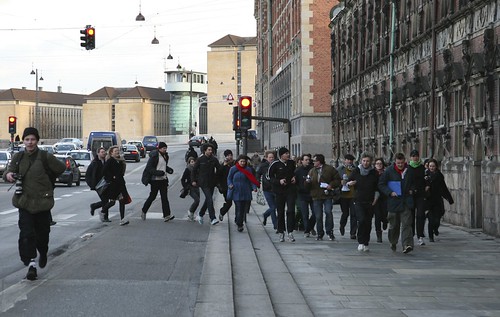
The Critical Run initiative, by Thierry Geoffroy, at first glance, appears exciting. Lighthearted and simple, yet livening. Take a group of people and make them discuss serious issues - while jogging. Let's run and talk. Let's have fun and share. Let's move. See what happens - to us, to the surroundings, to the topic. It reminds me of some of the Lone Twinworks, and of other, more discursive, initatives. But then you see the videos.
- and you realize why this is a copyrighted format. Actually, it's not about the conversation at all. It's about the hilarious situation of displacing discourse into a territory that is not its own. It's about creating a mess with a mass. And hoping (?) for a miracle of super-discourse through a discourse-smashing environment. As we all know from films, the most profound ideas arise on boxing rings. But wait! It gets better!
Oh, Canada! Think! Exchange! Travel far! As long as you can fit it on a headband...
But let's be honest. Discourse is a problem for the work of art, if it stays within the aesthetic experience. It either gets chewn up by the experience or we move out (last movement?) of the aesthetic experience and into the realm of plays-on-ideas. Which is also a tough blow. Then we have to face the perspective of functioning as anyone else who thinks. And running with them. And quite possibly getting completely lost, syncopated, out-of-breathed, shafted, as my teenage years would put it (notice the momentum of the word). No wonder one can feel the need to go back and, well, try to, well, do, well, something about the loss. Someone like John Baldessari*, witty enough to both play the artsy world and keep his eyes on the ball:
And, to get a fuller picture, how else, a remix of the remix:
Is the relief you feel when being able to read accompanied by a feeling of the loss of Baldessari's purity? Could it be there is not enough movement? But then again, isn't it nice to feel that a words translates into a thought? One of the videos of the Critical Runs is entitled "Does the artist has any impact on society?" (sic!) There is one comment underneath: "Not in bad English you don't. Does anyone have..."